



This article covers the same material I taught in the November Mastermind Meeting. If you’d rather watch me talk about this topic instead of reading it, you can watch that replay here.
I want to talk about something that affects every single one of us who publishes work online, whether we have a recipe website, a Substack newsletter, a YouTube channel, or some combination of all three: Discoverability.
More specifically, What are the questions for which you want your work to be the answer?
I know that some of you came to Substack precisely because you were tired of dealing with search engine optimization (SEO). I get it. I’ve been publishing recipes online since 2013, and I have spent an extraordinary amount of time trying to understand how search engines work and how to help people find my recipes. It’s not my favorite part of the job.
But here’s the thing: Even if you have no interest in SEO, you still want your work to be discovered.
We all do. Unless your Substack is purely a personal project, getting your work in front of people is kind of the entire point.
And what’s happening across the internet right now has implications for everyone who publishes online, including everyone who publishes on Substack.
The way people find information is changing rapidly. In some cases, the changes are happening so quickly that the technology is evolving while we’re still trying to understand it.
I don’t pretend to have all the answers. I’m figuring this out alongside everyone else. But I do think there are some things we can understand now and some thoughtful, strategic steps we can take to make our work easier to discover.
And even if you only publish on Substack, the place to begin is by understanding how search is changing. Those changes will come to Substack. In many cases, they already have.
From search engines to matchmakers
For years, we’ve thought about online search in fairly straightforward terms.
Someone wants to make an easy chicken dinner. They open Google, type “easy chicken dinners” into the search bar, and get a list of results.
The search engine’s job is to decide which pages are most relevant to that query and present them in some kind of order. For those of us who publish recipes online, the goal has been to get our recipes as close to the top of that list as possible.
That is the world of traditional SEO.
But increasingly, people are using AI-powered tools to find information in different ways. Today, online searches generally fall into three categories:
Traditional search: Someone types a query into Google and receives a list of websites, videos, and other results. This is still an important part of how people find information, but it's no longer the only game in town.
AI-powered search: Someone asks a more complicated question, and an AI system synthesizes information from multiple sources into an answer. Google’s AI Overviews and AI Mode are examples.
Agentic search: Someone gives an AI system a goal or task, and the system takes steps to accomplish it. Rather than simply answering a question, an AI agent might research options, compare them, monitor information over time, or complete parts of a workflow.
It’s this third category that I find particularly interesting for independent publishers.
Instead of someone searching for our work directly, an AI agent might search on that person’s behalf.
Think of AI agents as matchmakers. Their job is to understand what a person needs and identify information, resources, products, or people that might be a good match.
This has huge implications for discoverability.
An example from Siftr
I want to share an example from the Siftr newsletter, which publishes excellent information about SEO and search developments for food bloggers.
Imagine a home cook who wants dinner ideas delivered every Saturday morning, just before the weekly grocery shopping trip. Instead of searching for recipes individually, the person gives an AI agent a detailed request.
They explain that their partner eats dairy-free, their children won’t eat beans or legumes, and they want dinners that take 45 minutes or less. They have a slow cooker, an air fryer, and an oven. They usually keep chicken breasts, salmon, and ground beef in the freezer. They also want an itemized grocery list.
An AI agent could potentially use all of that information to search for recipes that meet the household’s needs.
Stop for a moment and think about how different this is from typing “easy chicken dinners” into Google. If you are a recipe developer who publishes quick and easy dairy-free recipes on Substack, your recipes might never come up in search results for “easy chicken dinners”.
But what if the AI agent this person uses knows that you are a recipe developer who publishes quick and easy dairy-free recipes that are exactly the kind of thing this home cook is looking for?
The AI agent might recommend your recipes because they fit the person’s specific requirements, even though the recipe would have been difficult to discover through a broad keyword search.
This is an exciting possibility. It suggests that the future of discoverability may depend less exclusively on whether your work comes up at the top of a reader’s search results and more on whether an AI system can recognize when that content meets someone’s needs.
I want to be careful here: Traditional search rankings aren’t suddenly irrelevant. AI systems may still use search engines and other established discovery systems to find information. But a high ranking for a broad keyword isn’t necessarily the same thing as being the best answer to a particular person’s question.
That’s an important distinction.
What we are already seeing is a mix of traditional search, AI overviews, and agentic search. Here’s an example:
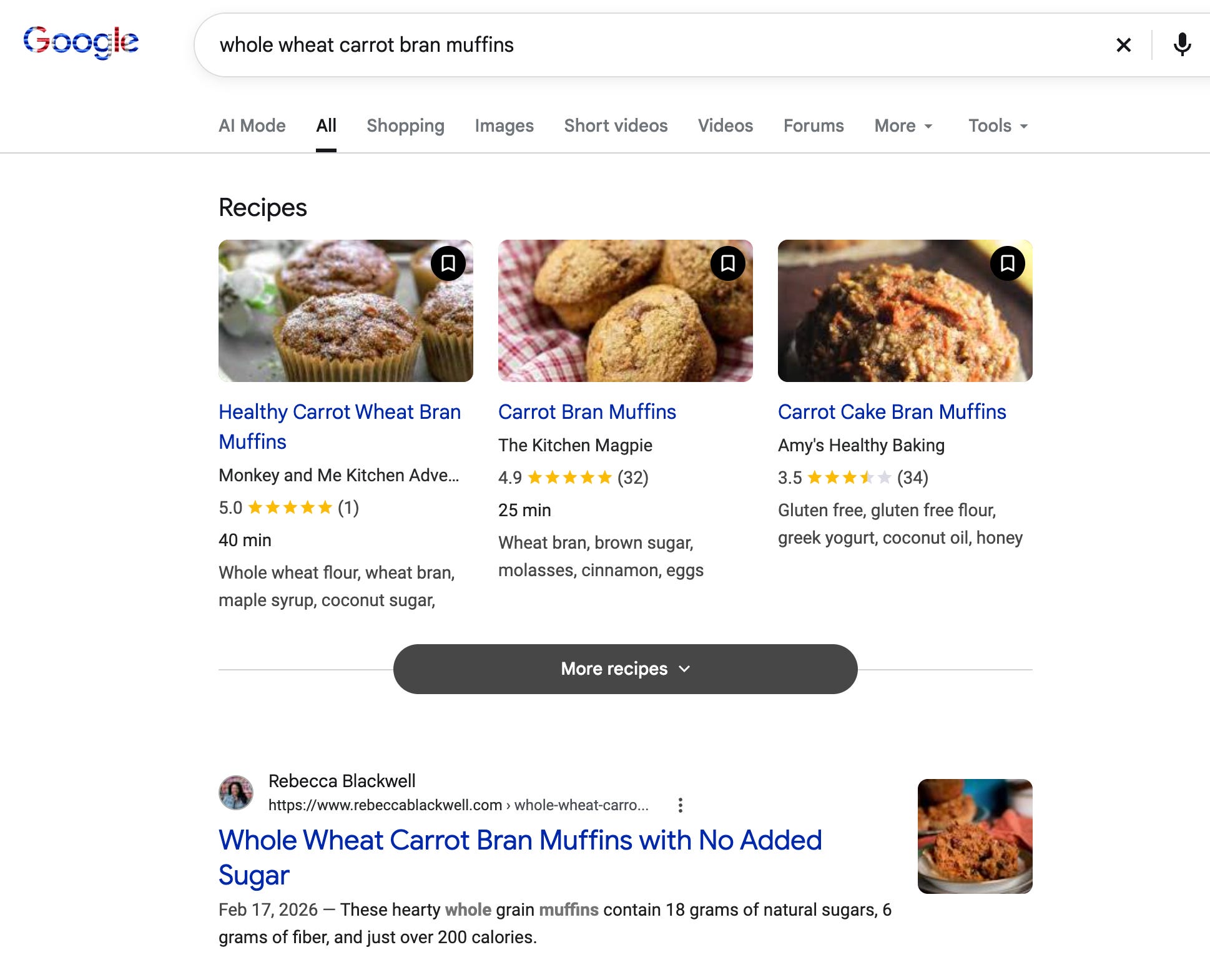
I published this recipe for Whole Wheat Carrot Bran Muffins here on Substack in February of this year. Because I formatted it as its own post and used the Substack recipe card, it is showing up in Google search results. Here is a screenshot.
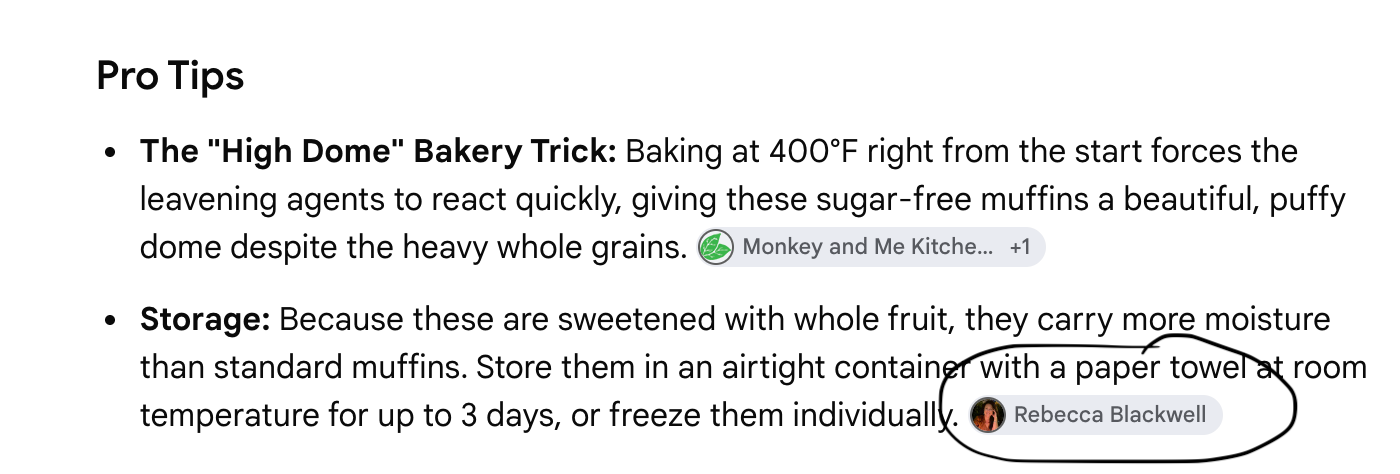
My recipe is also being cited in Google's AI Overview and AI Mode for related searches. The screenshot below shows the AI Overview that appeared when I searched for “whole wheat carrot bran muffins.” If the searcher clicks on my name, they will be taken directly to my recipe on Substack.
AI agents are already here
This conversation isn’t hypothetical. AI-powered agents are already appearing in the tools people use every day.
Google has introduced agentic capabilities that can help users research reservations and appointments, monitor certain kinds of information, conduct complex research, and, in supported situations, contact businesses for information.
Some of these capabilities are widely available, while others are limited by location, account type, or experimental access.
The important development is that people can increasingly ask AI systems to do more than provide an immediate answer. They can ask them to help accomplish something.
For example, imagine someone asking an AI system to keep an eye out for new zucchini recipes that fit their dietary requirements.
Instead of repeatedly searching for zucchini recipes, the person could receive recommendations when the system finds something relevant.
For publishers, that introduces the possibility of ongoing discovery rather than a single search that happens at a particular moment.
Meta has also been developing AI experiences that can use personal context, with appropriate permissions, to make recommendations and help people complete tasks.
Imagine someone looking for a dessert recipe for a work event. If an AI assistant knows that one of the attendees is gluten-free, it might factor that information into its recommendations.
Or imagine asking an assistant to find a dessert recipe a friend shared in a message, or to turn a saved recipe video into a grocery list.
These examples illustrate how personal context could make recommendations more useful.
In the grocery shopping world, Instacart has also been developing AI-assisted meal planning and shopping experiences that connect recipes with grocery lists and shopping carts.
The broader idea is that discovering a recipe, planning a meal, and buying the ingredients may become parts of a single connected process.
There is an enormous amount we don’t know about how all of this will work.
We don’t know exactly how different AI agents will select and recommend recipes. We don’t know how they’ll determine which publishers are trustworthy. We don’t know how often they’ll visit websites, how much traffic they’ll send, or how publishers will receive credit.
And we certainly don’t know whether every feature being developed today will become something people use regularly.
But we do know that AI agents have the potential to create new paths through which people discover our work, beyond the traditional search results page.
And that brings me back to the initial question: What are the questions for which you want your work to be the answer?
What I don’t want us to do
Before we talk about practical steps, I want to be very clear about three things.
Do not abandon what’s already working.
Do not stop writing for real, human readers.
And please, do not stop being yourself.
I’ve been publishing recipes online since 2013. During that time, I’ve watched countless SEO trends come and go. Every few months, it seems, someone announces a new strategy or shortcut that’s supposed to be the secret to getting more traffic.
For years, anyone publishing recipes online has been encouraged to find keywords with high search volume and low competition, structure posts according to increasingly rigid formulas, and pursue whatever tactic appears to be working in Google’s search results at the moment.
Some of those strategies have been useful. Others have encouraged an enormous amount of repetitive, unnecessary content.
I've never been particularly interested in playing these games, and I suspect that for many of you, escaping them was part of the appeal of publishing on Substack.
These days, before I publish a recipe, I ask myself this question: What can I add to the conversation?
I don’t want to publish a recipe simply because I found a keyword that appears relatively easy to rank for.
I want to create something useful. Something different. Something that adds value to what’s already available.
And I want to make it easy for people—and the systems helping them find information—to understand what that recipe offers.
That doesn't mean keyword competition no longer matters. But I think it gives us another reason to focus on creating genuinely useful, original work rather than chasing the latest SEO shortcut.
Make it easy to connect the dots
Here’s one of the most important ideas I want you to take away from this conversation:
Make it unmistakably clear who you are, what you create, who your work is for, and how everything you publish connects.
This has always been important for your readers. Now, it’s also important for search engines and AI systems who are trying to understand your work and play matchmaker.
Start with your About page. Does it explain, in detail, what your publication is about? Does it clearly identify who you are, what you write about, and who your work is for? Or is it filled with language that sounds lovely but doesn’t actually tell anyone what to expect?
Next, look at your Substack bio. Is it complete? Does it describe your work and experience? Does it link to the other places where you publish?
Then consider your welcome emails. Do they clearly explain what new subscribers can expect? Do they direct readers to important articles, recipes, series, or collections?
How organized is your content? If someone subscribes because they’re interested in a particular topic, how easy is it for them to find everything you’ve already written about that subject?
Substack has its own recommendation and discovery systems, and public Substack pages may also be indexed by outside search engines. We shouldn’t assume that all of these systems interpret information in the same way. And how all of these systems interpret and distribute information is a constantly moving target.
But no matter how things continue to change, this remains incredibly important: Clear descriptions, recognizable authorship, and well-organized content are sensible foundations for discoverability, regardless of the platform or how discovery changes.
If you publish in several places
Make sure there’s a recognizable connection between your name, the topics you cover, and the audience you serve.
Link your publications and profiles together where appropriate.
Use consistent descriptions of your work.
Make it easy for someone who discovers one piece of your writing to find the rest.
And look for opportunities to build genuine community around your work. Relationships and engaged readers matter. They create reasons for people to return, share your work, and recommend it to others. Those connections can also create new paths for discovery over time.
Is your expertise easy to find?
I want to share another perspective that I think is particularly useful.
Most of you know Sally Ekus, a literary agent who writes Not So Secret Agent here on Substack.
On various occasions, Sally has shared one of the ways she researches prospective authors. When she’s considering someone for representation, she searches for that person’s name alongside topics associated with the proposed cookbook.
She’s looking for evidence of relevant expertise. That might include articles, bylines, mentions in other publications, and signs of active engagement with the subject.
I think this is such a useful way to think about discoverability.
Imagine that you want to write a cookbook about cooking for one.
If a literary agent searches your name along with “cooking for one,” what will she find? Will she discover articles you’ve written about the subject? Recipes you’ve developed? Conversations you’ve participated in? Evidence that this is an area where you have something meaningful to contribute? Or will she find very little connecting your name with the subject you want to be known for?
This isn’t just about cookbook proposals.
It’s about new subscribers, freelance opportunities, media requests, collaborations, speaking engagements, sponsorships, and all sorts of other possibilities.
Being discoverable can create opportunities that lead to greater discoverability. It’s cyclical.
On Substack, we sometimes think about discovery almost exclusively in terms of gaining subscribers. But the potential is much bigger than that.
Sally’s example is about a real human person conducting research, but the underlying lesson applies to AI-assisted discovery as well. The big takeaway: If you want to be associated with a particular subject, make that association visible.
People are the point. They’ve always been the point.
Real people and recognizable experiences have always been compelling. Personal stories, testimonials, humor, and relatable experiences help readers connect with the work.
For food writers, our lived experience, firsthand recipe testing, photographs, distinct voices, and relationships with readers are our greatest strengths.
These are the things that make our work unique, ours, and difficult to replicate.
In this new age of discoverability, originality, personal experience, expertise, curiosity, perspective, and our unique voices are more important than ever.
Discoverability does NOT mean sacrificing what makes our work valuable in pursuit of discoverability. It means making that value easier to recognize.
Think about the discovery paths for each piece you publish
Here’s a practical question to think about whenever you publish something new: Who is this for, and how do I want them to discover it?
Not every piece of content needs to serve the same purpose. Some things we publish are primarily for our existing subscribers. Some are intended to attract new readers. Some are designed to establish expertise around a particular subject. Some might introduce people to a series, a product, a class, or another part of our business. And some pieces can do several of these things at once.
There’s not a right or wrong answer here. The important thing is to be as deliberate about discovery as you are about the work itself.
Consider how you publish recipes on Substack
If you want individual recipes to be discovered outside your subscriber list, consider publishing them as standalone posts rather than burying several recipes inside a longer newsletter.
Use Substack’s recipe card when appropriate. A structured recipe card can make important recipe details more explicit and may help compatible search and discovery systems interpret the content.
You may not want to do this with every recipe. Again, think about intent. What’s important is to understand how the format of your content affects its discoverability.
The same principle applies beyond recipes. If you publish a series about a particular subject, is it easy to find all the installments?
If you have written extensively about baking with sourdough, cooking for one, or food photography, can someone quickly understand the scope of your expertise? Are related articles connected? Are your headlines and introductions clear about what each piece offers?
Think carefully about paywalls and freewalls
This is another important consideration for Substack publishers. If you want a piece of content to be discovered through outside search engines or AI tools, consider how much of it is publicly accessible.
Content behind a paywall or restricted-access block may not be available to outside crawlers and discovery systems.
This doesn’t mean you shouldn’t use paywalls. If paid subscriptions are a part of your business model, use paid posts strategically and differently than you use posts that are written for discoverability.
What are the questions for which you want your work to be the answer?
Let’s return to where we started.
Start by imagining the person who would benefit most from something you’ve created.
What are they trying to accomplish?
What are they struggling with?
What do they need?
What are they curious about?
What questions might they ask?
Then think about the work you’ve already published.
Which pieces answer those questions?
And are you making that connection clear?
Have you grouped related recipes so someone can easily discover more of them?
The more clearly we understand the questions our work answers, the easier it becomes to communicate why that work is useful.
This doesn’t require turning every article into a question-and-answer format. And it certainly doesn’t mean stuffing keywords into every paragraph.
It means being intentional about the connection between what we create and what someone might be looking for.
Search for yourself
Open a private or incognito browser window and search your name alongside a subject you want to be known for.
What appears?
Is it recent?
Is it relevant?
Does it represent your best work?
Does it establish a recognizable connection between you and the subject?
Then try searching for a question a reader, editor, or potential collaborator might ask—without including your name.
What appears?
Who is being recommended?
What kinds of articles or resources are showing up?
What can you learn from the results?
Think of this as a useful diagnostic exercise rather than a definitive test.
Remember Sally Ekus’s advice. If someone searches for the subject you want to be known for, will they find you?
Practical ways to make your work easy to understand and navigate
There are several relatively simple things we can do to improve discoverability without fundamentally changing the work we create.
We can write clear, descriptive headlines.
We can use introductions that explain what a piece offers.
We can create meaningful categories and collections.
We can connect related articles and recipes.
We can make our author biographies and About pages more informative.
We can maintain consistent identities across platforms.
We can revisit existing work and update it when we have something useful to add.
And we can redistribute older pieces that deserve another opportunity to reach readers.
I think this last point is particularly important. We spend so much time creating new content that it’s easy to overlook the value of what we’ve already published.
But there may be excellent articles, recipes, and resources sitting in our archives that simply aren’t as easy to discover as they could be. Sometimes the best opportunity isn’t creating something new. It’s making something you’ve already created more useful, more accessible, or more clearly connected to the questions people are asking.
Be thoughtful and strategic. But don’t overthink it.
I know that all of this can feel overwhelming.
The technology is changing. The rules aren’t entirely clear. There are new tools, new terminology, and new predictions about the future of publishing almost every day.
And most of us are already working very hard. We’re writing, developing recipes, photographing food, editing, publishing newsletters, maintaining websites, building relationships, and trying to make our businesses sustainable.
The last thing any of us needs is another enormous list of things we’re supposedly doing wrong.
So I want to end with something that has always been true: Our job is to continue creating things that are useful, original, interesting, and worth reading—and to make those things easier for the right people to discover.
Be thoughtful. Be strategic. But don’t overthink it.
And keep coming back to this question: What are the questions for which you want your work to be the answer?
The future of discoverability may depend, at least in part, on how well we communicate what we know, what we create, and who we can help.
And that is something we can begin working on right now.
Three things you can do this week
Read your About page and bio as if you’ve never heard of yourself. Is it immediately clear what you write about and who it’s for?
Search your name alongside a topic you want to be known for. What do you find?
Choose one existing article or recipe and make its purpose, intended audience, and connection to related content more explicit.
Additional resources
If you’d like to explore these ideas in more detail, there are several resources available through Mastermind for Food Writers.
SEO for Food Writers: The class recording is available now and covers the foundations of SEO, including how I conduct keyword research and approach content strategy. I’ll continue refreshing the material as search evolves.
The Heart of Your Brand: This class helps you uncover the things that make your work unique, impossible to emulate, and difficult to ignore.
Business Strategy Meetings and the Paid Member Chat: These are ongoing opportunities to share ideas, troubleshoot roadblocks, test strategies, and make better decisions about how we invest our time and energy.
You can learn more about all of the resources in The Food Writers Business Lab here.
I also offer one-to-one strategic planning and SEO consulting sessions for food writers and recipe developers.
These sessions draw on more than 13 years of hands-on experience building my own online publishing business. They’re part education, part strategy, and part mentorship, with an emphasis on helping you develop a smarter, more sustainable approach to growth.
Sources and acknowledgments
Several people and publications helped inform this conversation, and I want to give them credit.
Siftr, the SEO newsletter for food bloggers, particularly its two-part series on AI agents and preparing recipe websites for agentic search.
Elizabeth at Curiouser, who generously shared her agency’s framework for creating content that is both captivating and discoverable.
Sally Ekus, literary agent and author of Not So Secret Agent, whose perspective on how agents research prospective cookbook authors offers a valuable lesson about the importance of recognizable expertise.
I’m grateful to all of them for sharing their knowledge and helping us think more clearly about the future of independent publishing.